










- Mode:
Instructor-Led Live Online
- Syllabus:
Job-Oriented
- Duration:
85 Hours
- Schedule:
Flexible
- Demo
Available
- Level:
All Level
Business Analyst Training with 8 Real Time Projects & AI Topics
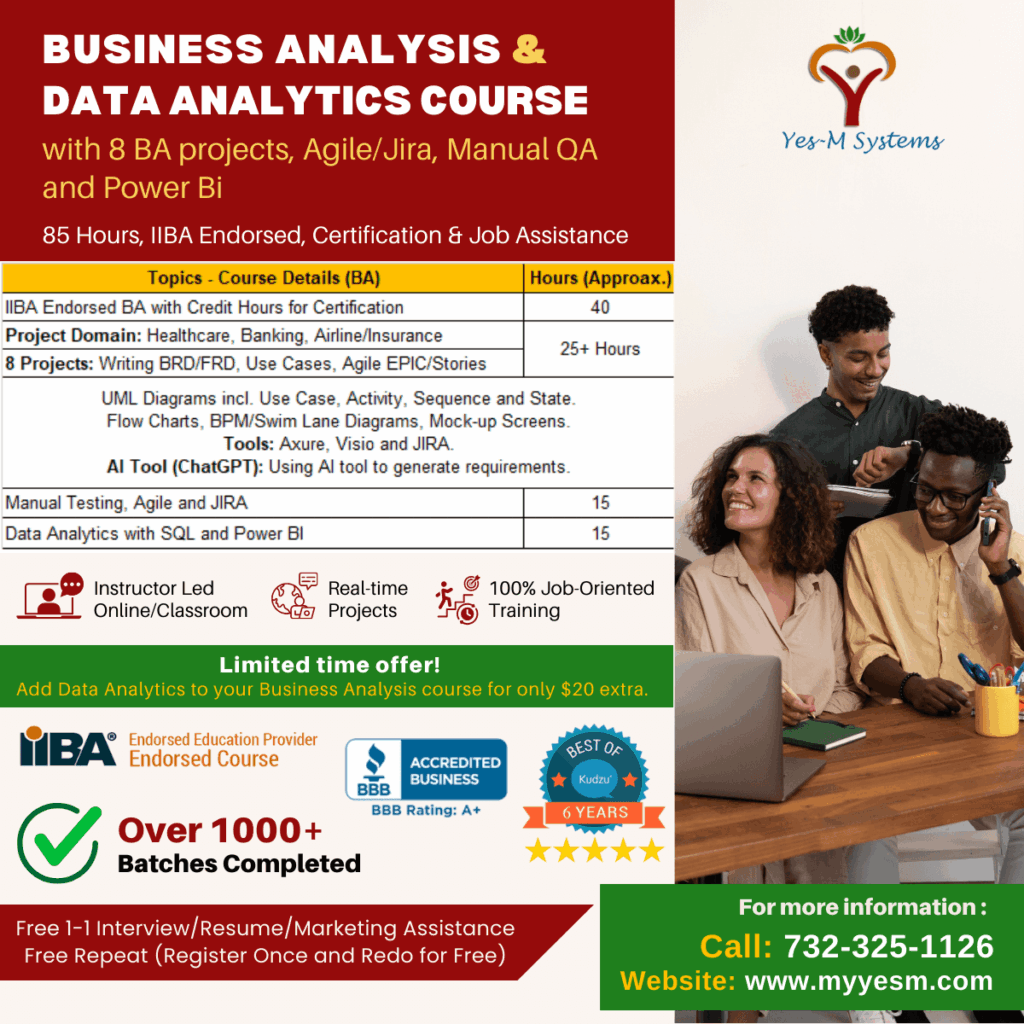
IIBA Endorsed Business Analyst (BA) Training Course - 85 Hours with 8 Real Time Projects, AI topics, Power BI and SQL.
8-9 weeks / 85 Hours
[65-70 Hours in class and 8 Real-time based Projects in Healthcare and Banking - 25+ Hours]
Empower your career with Yes-M Systems’ comprehensive Business Analyst Course and Placement Assistance Program (BA Training). This program is meticulously designed to equip you with the in-demand skills and knowledge necessary to excel in the dynamic field of business analysis.
Our Business Analyst Training and Placement Program pairs IIBA-endorsed training with 8 real-time projects, so you build job-ready skills backed by resume, interview and placement support.
This training will teach you the skills and knowledge you need to be a successful business analyst. Whether you are new to the field or have been working as a business analyst for years, this training will provide you with the tools you need to succeed. Register now and see how our training can help you take your career to the next level.
New Batches Starting Soon (September 2026)
This Business Analyst Course is designed to give students a solid knowledge in the role and responsibility of a Business Analyst. Topics are reinforced with intense hands-on practices including in class exercises, 8 Real-time based with reviews/feedback. This course is taught by two experienced instructors (i) with 25+ years of IT experience and (ii) PMP certified professional with over 20 years of experience.
This course will allow the students to understand various BA concepts including:
- 6 Knowledge areas of IIBA – Discuss Business Analysis, BA process, Role of a BA etc as per IIBA guidelines – 1. Enterprise Analysis, 2. Business Analysis Planning and Monitoring, 3. Elicitation, 4. Requirements Analysis, 5. Requirements Management and Communication, 6. Solution Assessment and Validation
- Software development methodologies (waterfall, Agile, Spiral, RAD, Scrum)
- Prototyping and JAD [Joint Application Development]
- Types of requirements (Business, Functional, Non-Functional, Transition, UI etc.)
- UML, Advanced UML [Unified Modeling Language]
- Project Management for BA’s
- Tools like Axure, JIRA, Quality Center and Visio (or STAR UML)
- Manual testing hands-on, related theory and SQL
- Interview Questions and Resume Preparation sessions
Business Analyst Training Program Comparison (2026)
| Feature | Yes-M Systems | Ad* | Sim* | Cou* | Ud* | H* |
IIBA Endorsed Programs |
|---|---|---|---|---|---|---|---|
| 🌐 Mode | Online only | Online (Live + Self-paced) | Online | Online | Self-paced Online | Online (Recorded) | Online or In-Person (varies) |
| ⏱️ Duration | 8–9 Weeks | ~60–80 hours | 4–6 Months | 4–6 Months |
Varies (5–30 hours typical) |
6–8 Weeks | Varies |
| 💲 Cost | ~ $545 | ~ $1,295+ | $1,000+ | Varies (Free–$800) | Low ($15–$100 per course) | ~$800–$1,200 | Varies ($900–$2,500) |
| 📚 Curriculum Highlights |
BA Core + Manual QA, SQL, Power BI, AI, IIBA Prep |
BA Concepts, BABOK, Case Studies |
Business Analyst Program |
Foundations + Practical Practice |
BA Fundamentals, Agile, Requirements |
BA + Agile, Jira, SQL, UAT, Healthcare |
ECBA/CCBA/CBAP exam prep |
| 🛠️ Tools Covered |
Jira, Power BI, SQL, Excel |
Jira, Bizagi, MS Visio |
Tableau, Jira, Agile tools |
Google Sheets, Excel, SQL |
Excel, Jira, Visio (varies by course) |
Jira, Confluence, SQL, Visio |
Varies by provider |
| 🎓 Certifications Included |
ECBA/CCBA/CBAP Support |
ECBA/CCBA/CBAP Support (IIBA Partner) |
Certificate of Completion |
Certificate from Google/IBM |
Certificate of Completion |
Certificate of Completion |
IIBA Certification Support |
| 🎯 Projects/Case Studies |
✅ 8 Real-time projects in Healthcare, Banking, and Airline |
Multiple case studies | 5+ Industry Projects | Multiple Assignments |
Some exercises (varies) |
2–4 Domain Projects | Varies |
| 👨🏫 Instructor Access |
Live Sessions + Mentorship |
Live sessions + mentor support |
Mixed (Live + Recorded) |
Self-paced (some mentor support) |
Limited – Q&A/Message Board |
✅ Live Instructor- Led Training |
Depends on provider |
| 🧪 Manual QA Testing | ✅ Included | ❌ Not included | ❌ Not focused | ❌ Not included |
⚠️ Some courses offer basics |
✅ Included | ❌ Typically not included |
| 📊 Data Analytics Tools | ✅ SQL & Power BI | ❌ Not focused | ✅ Tableau, MySQL | ✅ Basic data tools | ⚠️ Depends on course | ✅ SQL basics included | ⚠️ Varies |
| 🤖 AI for BAs (ChatGPT) |
✅ Included Prompts & Real-World Use |
⚠️ Limited / Not core focus |
⚠️ Limited / Optional add-on |
❌ Not included |
⚠️ Some courses may include ChatGPT |
❌ Not included | ❌ Not typically included |
| 🔄 Repeat Policy |
✅ Students can repeat the course for free for up to 1 year |
❌ Not offered | ❌ Not offered | ❌ Not offered | ✅ Lifetime access |
✅ Can attend repeat classes on request |
⚠️ Varies |
| 📹 Recordings Provided |
✅ Yes – Full class recordings available |
✅ Available | ✅ Available | ✅ Available |
✅ Yes (all courses pre-recorded) |
✅ Available | ⚠️ Varies |
🛡️ Disclaimer
This comparison is provided for informational purposes only.
Yes-M Systems offer a highly practical, instructor-led, and career-focused Business Analyst Training with strong support, making it a compelling option for many aspiring BAs.
Why Yes-M Systems’ Business Analyst Program Shines
- Focus on Practical, Job-Oriented Training with Real-Time Projects
- Experienced and Dedicated Instructors
- Comprehensive Curriculum Aligned with Industry Standards
- Strong Placement Assistance and Career Support
- Flexible Learning and Support
- Positive Testimonials and Reputation
Do I get any discount on the course?
Yes, you get two kinds of discounts. They are group discount and referral discount. Group discount is offered when you join as a group, and referral discount is offered when you are referred from someone who has already enrolled in our training.
Who will provide the environment to execute the Practicals ?
The trainer will give Server Access to the course seekers, and we make sure you acquire practical hands-on training by providing you with every utility that is needed for your understanding of the course.
What is the qualification of the trainer?
The trainer is a certified consultant and has significant amount of experience in working with the technology.
Does Yes-M Systems accept the course fees in installments?
Yes, we accept payments in two installments.
How does Yes-M Systems Refund Policy work?
If you are enrolled in classes and/or have paid fees, but want to cancel the registration for certain reason, it can be attained within first 2 sessions of the training. Please make a note that refunds will be processed within 30 days of prior request.
Business Analysis Course Curriculum:
1. Introduction
1.1. Introduction IIBA, BABOK
1.2. Introduction to BA roles/responsibilities
1.2.1. What is Business Analysis
1.2.2. Role of a Business Analyst
2. System Development Methodologies
2.1. Agile: Explain Agile
2.1.1. Scrum
2.1.1.1.1. Scrum Basics
2.1.1.1.2. Sprint
2.1.1.1.3. Product Backlog
2.1.1.1.4. Sprint Backlog
2.1.1.1.5. Burn down chart
2.1.1.1.6. Sprint Planning Meeting
2.1.1.1.7. Stand-up meeting
2.2. Waterfall method
2.2.1. Various SDLC phases will be covered in detail
2.2.2. Requirement Phase/BA’s role – covered in detail
2.3. Rapid Application Development (RAD)
2.4. Spiral
2.5. Agile and JIRA
2.5.1. JIRA – Introduction
2.5.2. JIRA tool registration( Trail Version)
2.5.3. JIRA – Dashboard
2.5.4. Managing Product backlog
2.5.5. Sprint Creation
2.5.6. Managing Sprint Backlog
2.5.7. Creating sub tasks
2.5.8. Sprint Progress and logging work
2.5.9. Reporting defects
2.5.10. Sprint Closer
2.6. Introduction to Various Requirement types [Note – some of these topics will be taught along with methodologies like waterfall or Agile or will be taught later in the course. Just explicitly documenting that these topics will be covered]
2.6.1. User/Business Requirements
2.6.2. Functional Requirements
2.6.3. Non-Functional Requirements
2.6.4. Transition Requirements
2.6.5. UI (User Interface) requirements
2.6.6. System Requirements
3 Business Analysis Process
3.1. Enterprise Analysis
3.2. Business Analysis Planning and Monitoring
3.3. Elicitation
3.4. Requirements Analysis
3.5. Requirements Management and Communication
3.6. Solution Assessment and Validation
3.7. Underlying Competencies
3.8. Techniques and Hands-on BA exercises
3.9. 8 Real-Time Projects
3.10. Project Management for BAs
3.1. Enterprise Analysis:
3.1.1. Define Business Need
3.1.1.1. Identify Business goal/Objectives
3.1.1.2. Identify the Business problem
3.1.1.3. Desired Outcome
3.1.1.4. Define/Document Business need
3.1.2. Assess Capability Gaps
3.1.2.1. Analyze current capability
3.1.2.2. Identify Gaps – problems/limitations
3.1.2.3. New capabilities required to meet the business need
3.1.3. Determine Solution
3.1.3.1. Identify Solutions
3.1.3.2. Identify methodology/Life-Cycle
3.1.3.3. Assess organization capability
3.1.3.4. Define Solution Approach
3.1.4. Define Solution/Scope (Project or Iteration)
3.1.5. Define Business Case
3.1.5.1. Feasibility Study
3.1.5.1.1. Costs, time, manpower, value/Benefits etc.
3.1.5.2. Other things to consider for an external product
3.1.5.2.1. Analyzing competition
3.1.5.2.2. Understanding the market
3.2. Business Analysis Planning and Monitoring:
3.2.1. Select business analysis approach
3.2.1.1. Understand Existing process/objectives/factors.
3.2.1.1.1. Plan Driven vs. Change Driven
3.2.1.1.1.1. Discuss various methodologies [as in System Development Methodologies]
3.2.1.1.1.2. Requirements for the current project
3.2.1.1.1.3. Analyze Deliverables
3.2.1.1.1.4. Prioritization
3.2.1.1.1.5. Change Management
3.2.1.1.1.6. Stakeholders and Approvals
3.2.1.1.1.7. Tools
3.2.1.1.1.8. Complexity of the project.
3.2.1.2. Conduct Stakeholder analysis
3.2.1.2.1. Who should participate
3.2.1.2.2. How many? The number of users
3.2.1.2.3. Indentify the business unit
3.2.1.2.4. Understand their approval level
3.2.1.2.5. RACI Matrix
3.2.1.3. Plan Business Analysis Activities
3.2.1.3.1. Identify business analysis deliverables
3.2.1.3.2. Determine Scope of work
3.2.1.3.3. When/What work will be done
3.2.1.3.4. Develop Estimates
3.2.1.4. Plan Business Analysis Communication
3.2.1.4.1. Type of requirement documents
3.2.1.4.2. Elicitation techniques
3.2.1.4.3. Communicate – Who/what/when/how
3.2.1.4.4. Business Analysis Communication Plan
3.2.1.5. Plan Requirements Management Process
3.2.1.5.1. Plan how changes are handled – Change Management
3.2.1.5.2. Plan how changes are prioritized/approved
3.2.1.5.3. Plan Traceability
3.2.1.6. Manage Business Analysis Performance
3.2.1.6.1. Track, Report and corrective actions
3.3. Elicitation:
3.3.1. Prepare for Requirement Gathering
3.3.1.1. Review/Understand Business needs/requirements
3.3.1.2. Plan what/when needs to be gathered
3.3.1.3. Identify who needs to be involved in this process
3.3.2. Conduct Requirement Gathering
3.3.2.1. Gather Requirements from the users/clients
3.3.2.1.1. Discuss various techniques used for gathering
3.3.2.1.1.1. Interview, Brainstorming, Focus Gps, JAD etc.
3.3.2.1.2. Other information to consider
3.3.2.1.2.1. Tracing requirements
3.3.2.1.2.2. Capture Attributes like Priority
3.3.2.1.2.3. Attributes of a good requirement
3.3.2.1.2.4. Where to collect the requirements
3.3.3. Document Elicitation Results
3.3.3.1. Meeting minutes/other written documents/recordings
3.3.3.2. Document Requirements
3.3.3.3. Document open issues/concerns/questions
3.3.4. Confirm Elicitation
3.3.4.1. Review Requirements with the stakeholder
3.3.4.2. Get approval from Stakeholders
3.3.5. Other
3.3.6. Prototyping (wireframe)
3.3.6.1. Explain Prototyping
3.3.6.2. Homework using Axure tool
3.3.6.2.1. Create a mock up screen using a prototyping tool
3.3.7. Joint Application Development [JAD]
3.3.7.1. JAD discussion
3.3.7.2. Role of a BA
3.3.7.3. Key Participants
3.3.7.4. Steps for a successful JAD session
3.3.7.5. Mock JAD Session
3.4. Requirements Analysis:
3.4.1. Prioritize Requirements
3.4.1.1. Basis for Prioritization
3.4.1.2. Challenges
3.4.1.3. Discuss MOSCOW
3.4.1.4. Timeboxing/Budgeting
3.4.2. Organize Requirements
3.4.2.1. Guidelines for organizing requirements
3.4.2.2. Level of Abstraction
3.4.2.3. Model selection
3.4.2.3.1. Why Models
3.4.2.3.2. Modeling Concepts
3.4.2.4. Techniques
3.4.2.4.1. Data Modeling
3.4.2.4.2. Process Flow Diagrams/Business Process Modeling
3.4.2.4.3. Use cases
3.4.2.4.4. User Story boarding
3.4.3. Specify and Model Requirements
3.4.3.1. Writing requirements (Stakeholder/Solution)
3.4.3.1.1. Guidelines
3.4.3.2. Matrix Documentation
3.4.3.3. Process modeling, prototyping, use cases, UML Diagrams
3.4.3.4. Define attributes
3.4.4. Define Assumptions and Constraints
3.4.4.1. Document Assumptions
3.4.4.2. Document Constraints
3.4.4.2.1. Business
3.4.4.2.2. Technical
3.4.5. Verify Requirements
3.4.5.1. Check for Quality
3.4.5.2. Various verification activities
3.4.5.3. Reviews
3.4.5.3.1. Internal Review
3.4.5.3.2. Customer/SME/Stakeholder Review
3.4.5.3.3. Team Review: BA, Customer/SME, Technology Teams
3.4.6. Validate Requirements
3.4.6.1. Business Value
3.4.6.1.1. Techniques for validating requirements
3.4.6.1.2. Deliver value to customers?
3.4.6.1.3. Aligned with business goals and objectives?
3.5. Requirements Management and Communication:
3.5.1. Manage Solution Scope & Requirements
3.5.1.1. Formal walk-through with the stakeholders
3.5.1.2. Getting the approval from the stakeholders
3.5.1.3. Changes
3.5.1.4. Baselining requirements
3.5.1.5. Change Management vs. Change Driven
3.5.2. Manage Requirements Traceability
3.5.2.1. Identify and document
3.5.2.1.1. Backward traceability
3.5.2.1.2. Forward traceability
3.5.2.1.3. Benefits
3.5.2.1.3.1. Impact Analysis
3.5.2.1.3.2. Requirements Coverage
3.5.2.1.3.3. Requirements Allocation
3.5.3. Maintain Requirements for Re-use
3.5.4. Prepare Requirements Package
3.5.4.1. (Possible) List of documents in a package
3.5.4.2. Documents for Vendor Selection
3.5.5. Communicate Requirements
3.5.5.1. General Communication
3.5.5.1.1. Enterprise Analysis Tasks
3.5.5.1.2. Elicitation Tasks
3.5.5.1.3. Requirements Analysis Tasks
3.5.5.1.4. Solution Assessment and Validation Tasks
3.5.5.2. Handling a Presentation
3.5.5.3. Who is involved in this process
3.6. Solution Assessment and Validation:
3.6.1. Assess Proposed Solution
3.6.1.1. Assessing a single solution
3.6.1.2. Assessing multiple solutions
3.6.1.3. Selecting a solution
3.6.2. Allocate Requirements
3.6.2.1. Solution components
3.6.2.2. Release handling
3.6.3. Assess Organizational Readiness
3.6.3.1. Cultural Assessment
3.6.3.2. Operational or Technical Assessment
3.6.3.2.1. Training
3.6.3.2.2. Documentation
3.6.3.2.3. Stakeholder Impact Analysis
3.6.4. Define Transition Requirements
3.6.4.1. What is Transition Requirements
3.6.4.2. Why it is needed
3.6.5. Validate Solution
3.6.5.1. Investigate Defective Solution Outputs
3.6.5.1.1. Requirement or
3.6.5.1.2. Application
3.6.5.1.3. Assess Defects and Issues
3.6.6. Evaluate Solution Performance
3.6.6.1. Post-implementation assessment
3.6.6.1.1. Understand and evaluate the value of the solution
3.6.6.1.2. Solution Replacement or Elimination
3.7. Underlying Competencies:
3.7.1. Analytical Thinking and Problem Solving
3.7.2. Behavioral Characteristics
3.7.3. Business Knowledge
3.7.4. Communication Skills
3.7.5. Interaction Skills
3.7.6. Software Applications
3.8. Techniques and Hands-on BA exercises are listed here:
3.8.1.1. Techniques
3.8.1.1.1. Decision Analysis
3.8.1.1.2. Estimation
3.8.1.1.3. Metrics and Key Performance Indicators
3.8.1.1.4. Risk Analysis
3.8.1.1.5. SWOT Analysis
3.8.1.1.6. Vendor Assessment
3.9. 8 Real-Time Projects: (Documenting BRDs/FRDs/Use Cases/EPICs/Stories): note – These Projects will be done throughout the course.
3.9.1. Project-1 – Creating a mock-up screen for a Healthcare application
3.9.2. In class exercise for Project-2
3.9.3. Project-2 – Airline Application – Writing an FRD/BRD
3.9.4. In class exercise for Project-3
3.9.5. Project-3 – Healthcare Application – Writing an FRD/BRD
3.9.6. Project-4 – Banking Application – Writing an FRD/BRD
3.9.7. In class exercise for Project-5
3.9.8. Project-5 – Banking Application – Writing a Usecase/UML diagram
3.9.9. Project-6 – Healthcare Application – Writing a Usecase/UML diagram
3.9.10. Project-7 – Healthcare Application – Agile-based – Writing EPICs/Stories
3.9.11. Project-8 – Banking Application – Agile-based – Writing EPICs/Stories. Completing various types of diagrams using Visio
3.10. Project Management for BAs:
3.10.1. Project Management for a BA
3.10.2. Why does a project need a BA and a PM – how the roles are similar and different
3.10.3. Project Charter and Project Plan
3.10.4. 5 Processes in a Project and the brief overview of Inputs, Tools and Techniques and Outputs – PMBOK table
4. Software Testing Life Cycle
4.1.1. Test Plan Preparation
4.1.1.1. Test Case Design
4.1.1.2. What is testing? Why to test?
4.1.1.3. What is a test case?
4.1.1.4. How to develop test cases from IT requirements?
4.1.1.5. Test Case Design Techniques
4.1.1.6. Test Cases: In class 9 to 10 Manual Testing Exercises and Homework
4.1.1.7. Cover real-time applications
4.1.2. Test Execution
4.1.3. Defect Reporting
4.1.3.1. What is Defect?
4.1.3.2. Bug Life Cycle
4.1.3.3. Defect Log Format
4.1.3.4. Understanding Priority and Severity
4.1.3.5. Example
4.2. Test Report preparation
4.3. Testing Types
4.3.1. White box testing
4.3.2. Blackbox testing
4.3.2.1. Functional
4.3.2.1.1. Smoke Testing
4.3.2.1.2. System Testing
4.3.2.1.3. End to End Testing
4.3.2.1.4. Regression Testing
4.3.2.1.5. Retesting
4.3.2.1.6. Concurrency Testing
4.3.2.1.7. Exploratory Testing
4.3.2.1.8. Compatibility Testing
4.3.2.1.9. User Acceptance (UAT) Testing
4.3.2.2. Non Functional Testing
4.3.2.2.1. GUI Testing
4.3.2.2.2. Performance testing
4.3.2.2.3. Security Testing
5. SQL, Advanced SQL
5.1. Introduction to SQL
5.1.1. SQL
5.1.2. Database
5.1.3. Table, Rows and Columns
5.1.4. Data Types
5.1.5. Primary Key, Alternate/Secondary Keys/NOT NULL/UNIQUE/CHECK and Foreign Keys
5.2. Statements
5.2.1. SQL
5.2.2. Select and Select *
5.2.3. Column Alias, Null Value, Arithmetic Expressions
5.2.4. Concatenation Operator(||), Literal, DISTINCT
5.2.5. Where
5.2.6. Order By (Desc, Asc)
5.2.7. And & OR, Like
5.2.8. Not
5.2.9. IN
5.2.10. Not In
5.2.11. Insert, Update, Delete
5.2.12. DESCRIBE
5.3. Advanced SQL with Oracle
5.3.1. SQL commands
5.3.2. Update, Delete
5.3.3. Create, Alter, Drop
5.3.4. Truncate, Select with various operators
5.3.5. Count, Sum, Distinct
5.3.6. Order by, Group by, Having
5.3.7. Working With Dates
5.3.8. Sub Query
5.3.9. Introduction to Joins
5.3.9.1. Inner Join
5.3.9.2. Self Join
5.3.9.3. Outer Joins – Left/Right/Full
5.3.10. Hands on all above with Oracle APEX online
5.4. Why QA professionals need to know SQL basics
5.4.1. Sample queries for data verification
5.4.2. acquiring test data
5.4.3. SQL Injection attack
5.4.4. What to test in Relational DB apps
6. Power BI
- What is Power BI?
- What is Power BI Desktop
- Install Power BI Desktop
- Exploring Power BI Desktop
- Power BI Overview
- Components of Power BI
- Exploring Power BI Desktop Interface
- Data Loading with Power BI Desktop
Types of different Data loading modes
- Excel, CSV, PDF, SharePoint, Folder
- SQL Data loading
- Cube Data loading
- Combining Data Source
Data Transformation with Power BI
- Transforming Database Data
- Connecting to access database data
- Power Query Editor and Queries
- Creating and managing query groups
- Renaming Queries
- Splitting Columns
- Changing Data Types
Power BI Visualization
- Designer Options
- Power BI Visualization Types
- Custom Visualization
- Best Practices
- Choosing Colors
- Types of Charts and Usage
PROJECTS
Build Practical Business Analysis Skills With 8 Real-Time Projects
8 Real-Time Projects: Documenting BRDs / FRDs / Use Cases / EPICs / Stories
Healthcare Application
Creating a mock-up screen for a Healthcare application
Airline Application
Writing an FRD/BRD
Healthcare Application
Writing an FRD/BRD
Mobile Application
Writing FRD and creating Mock ups
Banking Application
Requirement Gathering Project, Creating DFDs and Flow-charts
Healthcare Application – Agile-based
Writing EPICs/Stories and UML Diagrams
Healthcare Application – Agile-based
Writing EPICs/Stories and UML Diagrams
Banking Application – Agile-based
Writing EPICs and Stories. Completing diagrams using Visio
Work Across Different Business Domains
What You Get With Yes-M Systems Business Analyst Training
Everything you need to build practical Business Analysis skills and prepare for your next career opportunity.
Your Training
Included with the Business Analyst Program
BA Instructor Profile
Learn Business Analysis from experienced professionals with extensive industry and training experience.
Nandu
M.B.A (University of Alabama), M.S (Operations Research and Computer Applications)25+ years of experience in variety of areas that includes Training, Design, Development, Product Manager, Sr. Business Analyst, QA, IT Audit and Security.
IBM, EDS, BellSouth, Cingular, Sprint-Nextel, United Healthcare, and several start-ups.
CISA (Certified Information Systems Auditor)
CISM (Certified Information Systems Manager)
Ranjith KG.
B.E Computer Science and MS in Management15+ years of experience in variety of areas that include Business Analysis, Business Development, Testing and Support across Telecom, Banking, e-commerce domains.
Infosys, Cognizant, Capgemini.
5+ years and 100s of BA students, IIBA preparation, and Agile Training.
CSM (Certified Scrum Master)
Published articles on LinkedIn and most viewed writer in ‘Business Analysis’ space on Quora.
What Our Business Analyst Students Say
Real feedback from students who have trained with Yes-M Systems to build their Business Analyst careers.
Excellent Trainers!
I joined a BA course with Yes-M Systems and got placed in 3 months after completion. The trainers were patient and covered everything from the basics. I work for a top MNC today as a Business Analyst.
SimranExceptional Training
I took BA training and landed a job in two months after training. The entire training was excellent, with patient and knowledgeable instructors and a very hands-on approach.
Scarlet WhiteBest Trainer and Training Institute
After trying other BA training programs, I found Yes-M Systems different. The training, professional attitude and organized course structure were outstanding.
DivyaBA Training
The instructor was involved from the beginning, teaching the content while also providing guidance on career path and development. The course content was relevant and focused on real-time learning.
MitkudzuGreat Learning Experience
The BA course helped refresh my knowledge after a career break. The real-time project assignments helped me gain confidence and better understand Business Analysis.
Anu GuptaAwesome Training
The BA course provided a great learning experience and covered different aspects of the Business Analyst role. The assignments helped create a better understanding of the topics.
SwethaA Great Learning Experience!
Coming from a non-IT background, the BA training made the concepts easy to understand. The instructors were patient, and the assignments provided valuable real-life experience.
PoojaThorough, Intense and Project Based
The BA training was thorough, intense, fast-paced and project based. The course covered topics from basic to advanced areas including use cases, user stories, Agile, JAD and UML.
StyvtGreat BA Training
The training helped me understand the role and responsibilities of a Business Analyst in real-world situations, including requirements gathering, Visio, UML, use cases and methodologies.
Raj KumarStructured Business Analyst Training
The BA curriculum was very structured and the trainers explained everything clearly without rushing through the course. I would recommend it to people looking to learn or change their career.
GeetaExcellent Training
The BA training included excellent course materials, assignments and reviews. The instructors took time to ensure students understood the concepts instead of simply completing the assignments.
Alagar SamyExcellent BA Training
The instructors were knowledgeable and explained topics in a simple way. The course included hands-on assignments based on work environments, making the learning practical.
DharmaWorth the Money
The BA instructors were knowledgeable and helpful. They explained concepts using real-life examples, making the material easier to understand and remember.
RichardBusiness Analyst Job Oriented Training
The online BA training provided experienced faculty, individualized attention and guidance in areas where additional support was needed to build career skills.
VenkaComprehensive BA Curriculum
The Business Analyst course had a comprehensive curriculum, knowledgeable trainers, interactive sessions and realistic examples and assignments that provided hands-on practice.
KrishnaReal-Life Examples & Hands-On Training
The BA training provided a good balance between theory and practical exercises, with plenty of real-life examples and hands-on training.
John RickIntense but Excellent Training
The BA instructor was knowledgeable and used practical examples and scenarios to help students understand the material. Evening classes were also convenient and flexible.
PhilipExcellent Way to Start
The BA classes were interactive and provided plenty of hands-on experience. The training also offered guidance and support for people coming from non-technical backgrounds.
SumairaBest BA Training
The BA curriculum was well organized and helped explain the concepts clearly. Sample projects, hands-on practice, interview preparation and resume support were especially helpful.
VijayTop Notch BA Training
The Business Analyst course covered everything needed to understand the BA role. It was suitable both for people entering Business Analysis and experienced professionals looking to gain more knowledge.
JayTake the first step toward your professional career.
Start Your Business Analyst Journey
Take the next step toward a successful career with our Business Analyst Training. Learn industry-standard business analysis techniques, AI-powered tools, and gain practical experience through 8 real-time projects in Banking and Healthcare. Whether you’re a fresher or a working professional, our expert-led training, resume building, interview preparation, and placement assistance will help you become job-ready.
Build your Business Analyst career with confidence. Enquire today!
Business Analyst Interview Questions & Answers →Sign Up & Get 10% Discount!
Disclaimer: Yes-M Systems and/or their instructors reserve the right to make any changes to the syllabus as deemed necessary to best fulfill the course objectives. Students registered for this course will be made aware of any changes in a timely fashion using reasonable means.